Materials Spotlight: Montessori Vocabulary Lessons
Rebecca Lingo • April 6, 2026

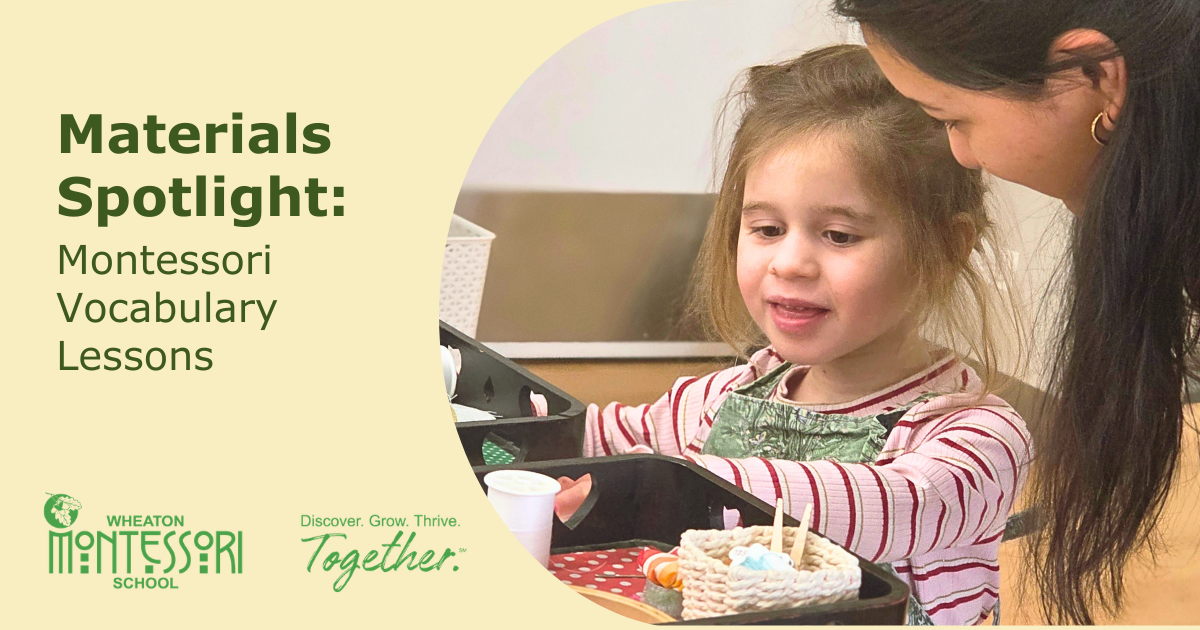
This blog shares a powerful lesson we use to teach young children new vocabulary. Let us support you while your children’s minds are especially absorbent for language. Read on for how we give three-period lessons. We use it constantly for phonetic sounds, geometric shapes, textures, quantities, biology terms, countries and continents, and so much more. Virtually every time your children learn precise new words here, we have presented the terms in our three-period lesson format.


The Simplicity of the Three-Period Lessons


Here's how our three-period lessons unfold. We’ll use a classic example of teaching the words "rough" and "smooth" with our textured touch boards.


1. ASSOCIATION — "This is..."


The teacher presents the object and names it clearly, with no extra words. Your child repeats the word while experiencing the sensation. 


"This is rough." 


Your child runs their fingers across the surface and repeats: "Rough." 


Repeat this first stage many times with a focus on the adult stating the vocabulary word and identifying the named object.


2. RECOGNITION — "Show me..."


After repeatedly pairing the name and object, the teacher asks your child to identify the object by name. 


"Which is smooth? Which is rough?" 


Your child simply points or touches. Your child can remain quiet during this stage while demonstrating understanding by pointing. Repeat this stage many times until you believe they are confident. They may even volunteer the name without being asked, but they can also remain quiet during the longest of the three periods to reinforce the vocabulary word.


3. RECALL — "What is this?"


The adult points to an object, and your child says the name themselves. 


"What is this?" 


Your child touches the surface and answers: "Rough."  


If the learner struggles or pauses, return to the second period. Often, only the first two periods are used for children learning an additional language, who are not yet verbal, or who are under three.


Teaching this at Home


Don’t purchase Montessori materials or anything new for this activity. Use items in your daily life that offer opportunities for more detailed vocabulary. 


When you use the airfryer, try introducing words such as “heat setting”, “basket”, “timer”, or ”parchment liner”. It can even be fun to listen together for the “fan” or the “timer bell”? 


Any time you want to help a young child connect a precise word to something they're experiencing (the names of: spice smells, facial expressions, dinner ingredients, plants, instrumental sounds, car parts, architectural features, etc.), the same three-step structure applies. 


Name it clearly many times. 

Ask them to show you many times. 

Ask them to name and identify it as many times as is fun. 


Keep it brief, keep it joyful, and if they get stuck, simply set it aside and repeat another time.


The lesson works because it is designed for how young minds learn. Children learn vocabulary in stages: first association, then recognition, and finally recall. It is particularly fun to share because it can be done anywhere, with anything, and offers something to do together. 
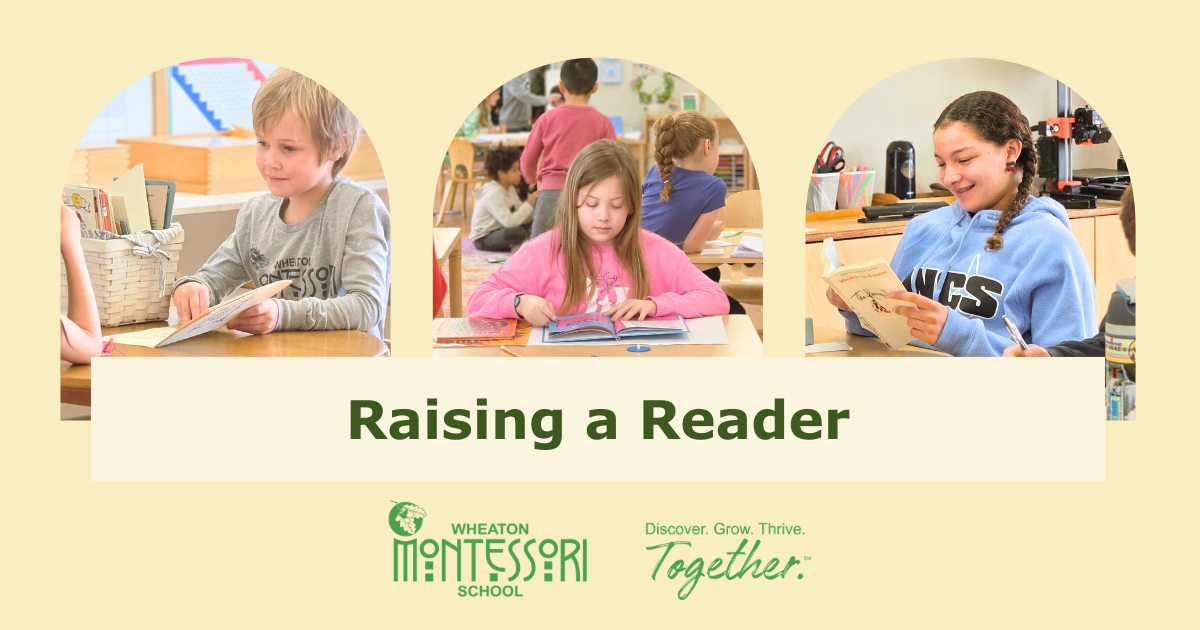
Three children engage in reading activities in a classroom, with text below reading,
By Suzanna Mayhugh, Lower Elementary Teacher April 13, 2026
Without fail, most of my Parent-Teacher Conferences end with a parent asking, “What can we be doing at home?” And without fail, I respond, “Read. Read with them, to them, next to them, near them. Even if they read themselves. Keep them reading.” Reading is a skill that must be practiced, over and over again. Enjoying a book is not a skill that we’re born with in Kingdom Animalia. It’s a skill we learn by watching those around us, modeling reading as young children, trying over and over to find the book that hooks us for life. But what if your child doesn’t love reading? What if it’s a battle at home? Here are a few tips that I’ve learned from my fellow teachers, from my time as a parent, and from observing students in the classroom. Start early! Read to them as soon as you get them home for the first time! Not only does reading at a very early age have language comprehension, memory, and narrative skills implications for later in life, it also helps create a bond and habit early on. Feeling late to the party? Start now! Let them pick books they like. Are they choosing the same book again and again? Great! They’re reading! Are they reading the 8453rd installment of Rainbow Magic Fairies? Good! They’re reading! Diary of a Wimpy Kid? Great! The graphic novel of the comic based on the novel they already read? GREAT! Is your pre-reader paging through Goodnight Moon for the 54th time today? Wonderful. There is so much research showing repeated exposure to the same book supports fluency, automaticity, narrative expression, comprehension, and confidence at all levels of reading. Have books in every room. Like all new skills, without access to the needed tools and equipment, those new skills don’t get practiced. Stock your bedrooms, bathrooms, kitchens, and cars with books. (My family has rules about the dining room table during dinner, but that rule can bend quite quickly when someone is “at a good part.” Assess what they are filling their time with instead of reading. Do they actually have time to read? Is there ever a “down” moment that they would even be able to fill with reading? Often, lack of time is one of the biggest obstacles. If your child wants to be in every after-school class, on the travel teams, or you’re just always coming-and-going, keep books in the car. Load your playlist with audiobooks (yes, they “count” as reading). And here’s where I lose some of you: Is what they are doing instead of reading something your family values? Are they watching videos of other kids playing Minecraft? Are they doom-scrolling at the age of 7? Are they on YouTube Shorts for hours? If so, the chances of them picking up a book, which takes mental work, isn’t high. If you want to help your child love reading, you have to assess what they’re doing instead of reading. Still with me? Make reading a moment for connection. Your children idolize you. They want your attention. They want to feel close to you. Build on that desire. Read to them for as long as they will allow. I promise, your teenager wants these moments. Your three-year-old craves these moments. Make the effort to build it into your routine to read together and guard that moment with all that you have. Let them put down books they don’t like. Do you remember being forced to finish a book in school, just so that you could be quizzed on it? To tell the adult asking you to read it that yes, you’d indeed finished it against your own judgment and free will? Don’t be the one that does that to their reading enjoyment. If they don’t like a book, let them move on to the next one. Is the book they detest your childhood favorite? I see you, I feel you, I’ve been you. It stings when your daughter does NOT feel the same way about Mrs. Piggle-Wiggle as you did in second grade. Even worse when it’s From the Mixed-Up Files of Mrs. Basil E. Frankwieler. Just let them move on. It’s not worth the heartache of trying to convince them. Trust me, I know. Give them variety - and don’t talk down about their favorites. Allow them to read across a wide menu of options: graphic novels, comics, short stories, mysteries, picture books at an older age, a series that makes you want to roll your eyes. Not a fan of graphic novels or comics? Please don’t require “serious reading” before they get to something “fun.” That implies that some reading is automatically a drudgery - which will lead to avoidance altogether. Don’t overlook comics and graphic novels. Leaf through some at the library and see how they’ve evolved over the last decade. Comics are also shown to increase vocabulary, strengthen sequencing skills, and provide art education. Even better, comics and graphic novels can be a bridge for students with dyslexia, autism, and attention challenges. Don’t overlook them as a very helpful, brightly-colored tool in your reader’s toolbox! Remember - the goal is to get them reading to begin with and let them find what they love through the process. When I was a Wheaton Montessori School parent with young primary children, well before I took the AMI Elementary training, their teachers, Ms. Chiste and Mrs. Fortun, recommended “The Rights of the Reader” by Daniel Pennac during several of their parent workshops. I’d like to pass along the recommendation, as it has served my family - and teaching - for years now. Learning to love reading is a skill, just as reading itself is. Research is showing that we’re headed in the wrong direction, with just 1-in-3 public school fourth graders in Illinois reading proficiently, and college students at top universities being unable to follow or complete full books. Your chances and opportunities for “raising readers” are at-hand, so be off with you to the library! https://www.theatlantic.com/magazine/archive/2024/11/the-elite-college-students-who-cant-read-books/679945/ https://www.illinoispolicy.org/literacy-epidemic-hits-illinois-as-fewer-than-1-in-3-students-read-well/
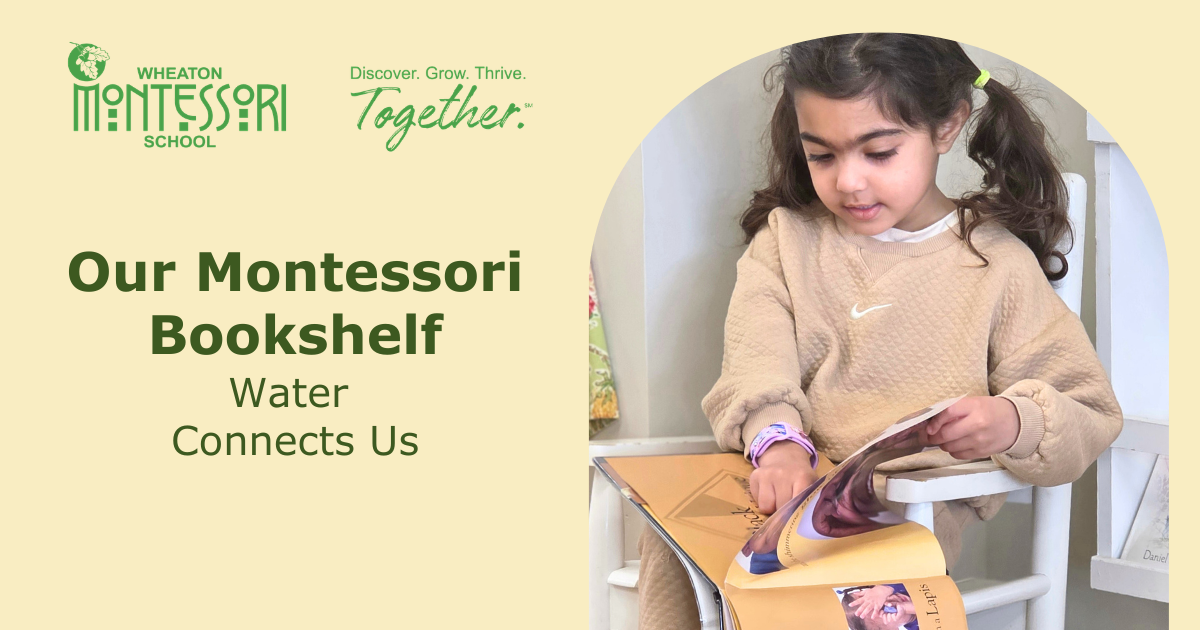
A young girl reading a book, seated in front of a neutral-colored background.
By Rebecca Lingo March 30, 2026
Explore a curated list of children’s books about water, rivers, and watersheds. These stories invite curiosity, care for the planet, and meaningful reading at home.