At Wheaton Montessori School, we emphasize two words on a regular basis: grace and courtesy. But what does grace and courtesy mean? How are they an essential part of Montessori classrooms, specifically at Wheaton Montessori School? And what role do they play in supporting the development of social relationships and confident humans?
What is Grace? What is Courtesy?
Let’s first isolate each word. Google’s Oxford Languages defines “grace" in two parts: 1. simple elegance or refinement of movement, and 2. courteous goodwill. Courtesy is defined simply as the showing of politeness in one’s attitude and behavior toward others. Stated another way, grace and courtesy comprise how we move through the space around us showing respect for ourselves and others.
Grace and courtesy are fundamental aspects of Montessori education and are taught and expected to be demonstrated in different ways across various age groups, specifically in the preschool and kindergarten, elementary, and adolescent stages.
Grace & Courtesy Lessons at Wheaton Montessori School
Preschool and Kindergarten
In our preschool and kindergarten communities, grace and courtesy are considered to be part of practical life learning and we devote significant time to grace and courtesy lessons. For example, the adults give explicit instructions on how to walk around someone’s work on the rug, how to wait your turn, how to offer help, how to tuck a chair under the table, or how to introduce oneself. These lessons are offered one-on-one or in small groups and we role play to discover new skills.
We are very careful about how we introduce grace and courtesy to children. If we see something that needs to be addressed, we try to avoid confronting the child in the moment and we never offer grace and courtesy lessons as a form of punishment or correction. We are careful about this because children are often embarrassed when corrected by adults on the spot. When this happens, they can feel disrespected and not safe, and thus much less likely to perform the act on their own accord.
Elementary Program
As children enter their elementary years, our approach shifts slightly. Elementary-age children are more focused on their social interactions and are learning how to navigate the ups and downs of friendships and are continuously learning and experiencing how to handle different situations within their social circles. As such, much of the grace and courtesy work at this level provides children with tools for communicating directly and respectfully, sharing perspectives thoughtfully, and even being discreet about something potentially embarrassing. In addition, they are learning how to interact with the broader community as they arrange visits or interviews, conduct themselves according to the norms of different communities, and explore how to be a host or a guest. They foster a sense of responsibility and respect towards others and the environment.
Adolescent Community
When it comes to adolescents, grace and courtesy are further expanded and refined. Teens are expected to have mastered the basics and are now taught how these concepts apply on a broader scale. They learn about ethical behavior, critical thinking, and decision-making. They experience and explor how to navigate complex social situations, respect all, communicate effectively, and collaborate with others. They are encouraged, supported, modeled, and taught to demonstrate these behaviors in real-world situations, helping them prepare for adulthood.
In summary, grace and courtesy are integral parts of the educational journey at Wheaton Montessori School. They evolve and differ in complexity depending on the age group, starting with basic manners in preschool and kindergarten, progressing to more complex social interactions in elementary, and culminating with ethical behavior and decision-making in adolescence.
The Goal
At Wheaton Montessori School these acts of grace and courtesy aren’t rigid demands. For example, we do not like insisting that children say please and thank you. We want students to voluntarily use these niceties because it’s part of living together, they are surrounded by courtesies, and they recognize the relationships. They become part of how children want to be and interact. The expectations are modeled, taught, encouraged, and supported. Dr. Montessori is quoted as saying: “…the essential thing is that [the child] should know how to perform these actions of courtesy when his little heart prompts him to do so, as part of a social life which develops naturally from moment to moment.”
Like all academic, practical, and social activities within our classroom communities, we offer opportunities to regularly practice and repeat grace and courtesy skills. Because these experiences are part of the normal functioning of the day, they provide a respectful way for young people to learn expectations and for adults to inspire, model, scaffold, and assist social skill development.
The Results
As we offer these grace and courtesy opportunities and give children a safe place to practice, our young people eventually perform these skills independently.
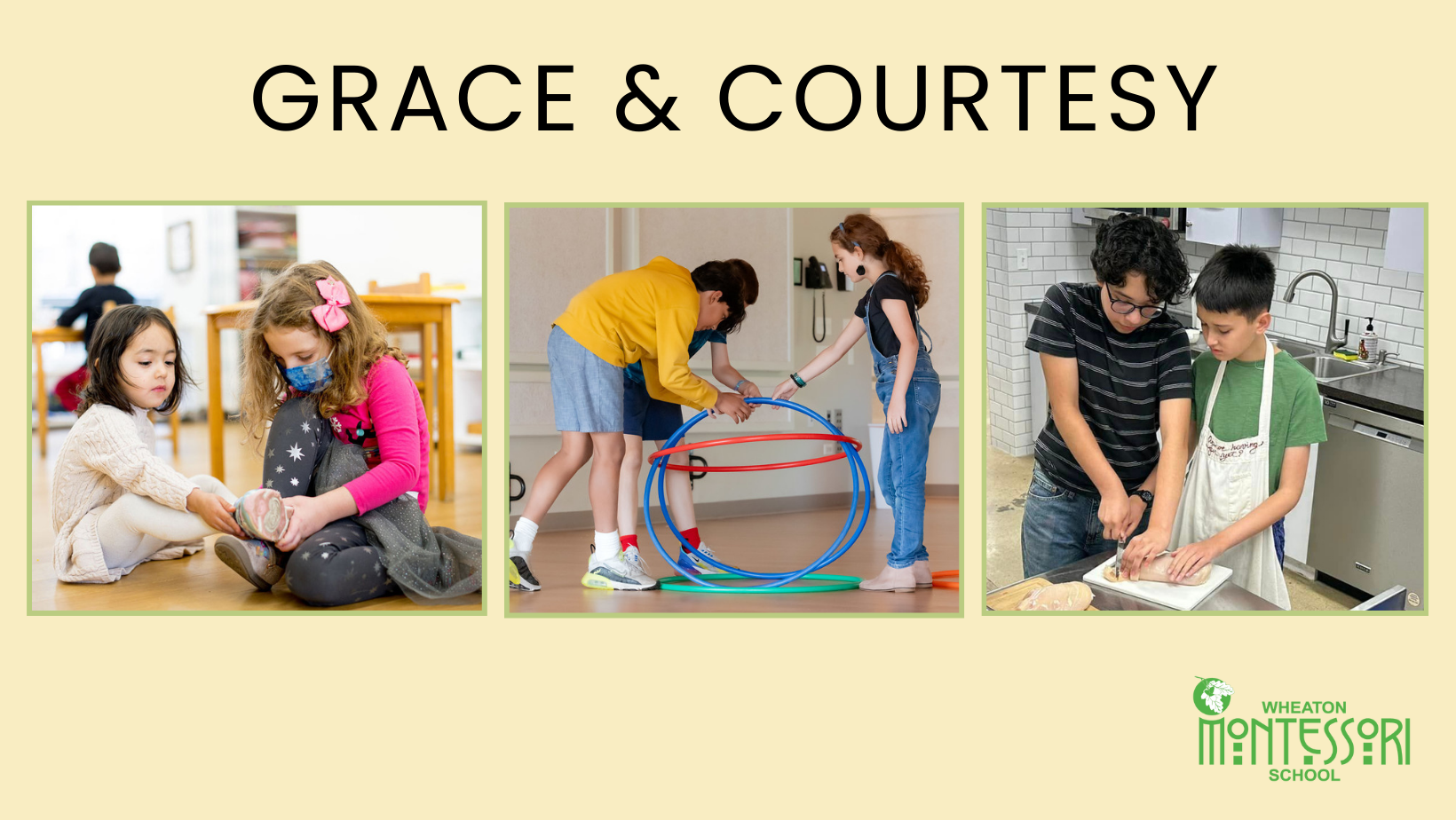
Upon your initial visit to Wheaton Montessori School, you probably encountered an incredibly focused, purposeful, and joyful environment in all of our programs. You might have observed two young kids seated together, with one patiently assisting the other in putting on their shoes. There could also have been a student waiting calmly to share a story with the teacher. Your children bring a sad classmate a tissue or rush to assist when someone has a spill. They tuck their chairs under tables. They carefully place a tray on a table. They greet each other and adults in the hallways. They hold the door open when they see someone coming in their way.
In summary, in each of our programs, students are always encouraged and guided to work with grace and courtesy. Interactions at Wheaton Montessori School are done in a manner that is peaceful, respectful, and cooperative and are marked by mutual understanding and a sense of unity. Students share their spaces, resources, and time in a way that promotes harmony and fosters a sense of community. This harmonious coexistence among children is a testament to their innate ability to learn together peacefully and treat each other with grace and courtesy.
Your children as part of Wheaton Montessori School students and as future alumni move beyond the basic niceties and think deeply about their impact on those around them. We’d love to show you this in action. We invite current families to schedule classroom observation and prospective families to schedule a school tour to see the ways that grace and courtesy help children recognize themselves as caring, competent, and cooperative individuals within a community together.