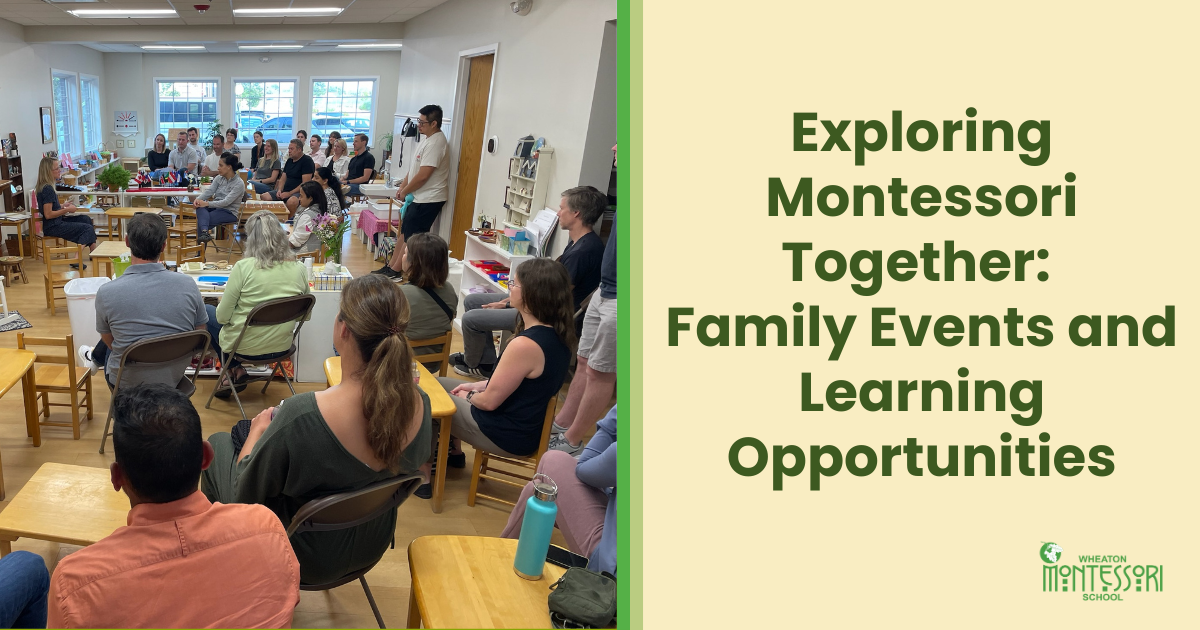
Exploring Montessori Together: Family Events and Learning Opportunities
Rebecca Lingo • November 4, 2024

Many of us didn’t grow up with Montessori. As a result, we often find ourselves drawing upon a great deal of trust. We may intellectually understand how this unique method supports our children and their development. Still, we don’t always have the experiential knowledge to explain how and why it works!


We understand that life can be busy, and we aim to provide you with valuable information to help you address your questions and those of others. Additionally, we believe that the more engaged you are, the greater your chances of understanding the authentic and accredited Montessori education we provide, ultimately enhancing your child's experience with Montessori's child-centered approach!


Goals for Family Education Events


At Wheaton Montessori School, we have some goals as we design parent and family education events. We want to deepen your understanding of Montessori philosophy and practice. We want to work together in partnerships, and we often hear that families want to better understand how Montessori can be implemented at home. We are excited to help with this, especially knowing that when we are all aligned, we can work together to foster independence, responsibility, and self-discipline in our children.


Supporting Your Child’s Development


We hope that as you learn more about what we do and as we learn more about what you do, we can use a shared understanding of Montessori principles to support your child’s development both in and outside of Wheaton Montessori School. Understanding developmental stages through a Montessori lens often leads to children feeling a stronger sense of belonging and connection because they feel understood and supported. This can translate into easier day-to-day interactions, better collaborative problem-solving, a long-term love for learning, and an increase in confidence and independence. 


Partnership in the Parenting Journey


We want to help build a strong home-school partnership. Through consistent and varied communication and learning opportunities, we hope to create a collaborative environment and opportunities for meaningful dialogue. Parenting is a tough job, and we want to ensure you know you aren’t alone on this journey! Through different platforms, we aim to address common misconceptions and help you feel good about answering questions that come up at family gatherings and neighborhood events! 


We cherish an engaged community and aim to foster your connections with fellow families from Wheaton Montessori School. By sharing experiences and challenges with like-minded parents, we can navigate the ups and downs of parenting together. Our goal is for our school community to offer both emotional support and practical guidance.


Ultimately, we want you to gain a deeper understanding of the Montessori education we offer. This knowledge will empower you to effectively advocate for your child's learning and prepare you for the transitions they will face at various stages of their life.


UPCOMING EVENTS AT WHEATON MONTESSORI SCHOOL


We hope you can join us for our upcoming Parent Discovery Nights and Better Together Get-Together event. We value your participation and your partnership! 


Parent Discovery Nights

During the Parent Discovery Nights, you will gain insights into the curriculum and ask questions. There will be interactive sessions to engage with your child's daily materials and methods. This is a great chance to connect with other parents and foster a supportive community for nurturing children's growth. Please RSVP by clicking on the links below for the events you will attend. Prospective Families, please kindly note that the only Parent Discovery Night available for your participation is the Primary one. 


Better Together Get-Together

As parents, we aim to ensure our children's well-being and success while balancing control and freedom. Join Ms. Christine Carr, one of our primary teachers, to explore the concept of "lighthouse parenting”. We stand strongly like a lighthouse and guide our children with support without dictating their actions. This approach helps children build confidence and resilience as they learn to navigate life's challenges independently.


All families are invited to attend to socialize and increase their knowledge of lighthouse parenting. Toddlers are welcome in our playroom during the meeting.


In addition to attending our school events, prospective families interested in our school are encouraged to schedule a tour by clicking on this link or the green Schedule a Tour button on the upper right-hand corner of this page.

Children outside a building; title
By Suzanna Mayhugh, Lower Elementary Teacher January 19, 2026
Montessori Mayhem? Pint-Sized Pandemonium? When I give tours of the Elementary classrooms or welcome new parents to the Elementary program at Wheaton Montessori School, some parents believe that students are allowed complete freedom, as if the classrooms are a beautiful den of chaos and anarchy. Indeed, this is one of the biggest misconceptions about Montessori education. (The biggest misconception being, in my experience, that Montessori isn’t “real world” education. But as we say in our lessons, “That’s a story for another day.”) While Montessori classrooms DO give children the freedoms they require and deserve, it’s not an unlimited free-for-all with an adult watching from an observation chair! Freedom is always balanced with responsibility, to oneself and to the community. These values, freedom and responsibility, are essential for creating a happy, busy, humming classroom where children thrive. What Does Freedom Mean in Our Classroom? “Freedom” in the classroom means that students are encouraged to make choices about their learning. Just as in our Primary classrooms at Wheaton Montessori School, students are free to choose their work, their seat, and their work partners. They are free to move about the classroom and do not need to raise their hands to visit the restroom, get a drink of water, or ask a question. Let’s look at a few of these freedoms more closely. Students are Free to Choose Their Work. For example, they may choose which book to read, choose a work partner to research a chosen topic, or practice a tricky bit of a lesson over and over. They are also able to choose how they will show their understanding. They might present their understanding through a poster, a diorama, a model, a handmade book, or an enormous amount of cardboard and hot glue. These choices empower students to take charge of their education and express themselves in ways that suit their interests and strengths, something a standardized test or a worksheet can never do. However, freedom in the classroom ALWAYS has limits. For example, students are free to choose their work, but choosing NOT to work is not an option. They are free to choose their work from the lessons that have been presented to them. While students may choose their reading material, it must be appropriate for their reading level and classroom guidelines. When students select a partner, they must do so respectfully and inclusively. When students create projects and work output, they must do so with care, make proper use of materials, and in a way that shows what they understand about their topic. Additionally, these choices should never disrupt their own learning and construction, or that of their peers. The Role of Responsibility In a true Montessori classroom, freedom comes with responsibility. And that responsibility can sometimes be uncomfortable at first. Students are expected to care for classroom materials, such as returning books and lesson materials to the shelf, taking part in classroom jobs, keeping a record of their work in their work journals, and handling art supplies properly. They are responsible for practicing their lessons and completing chosen follow-up work, listening attentively during lessons or when a classmate is sharing a presentation or thought, and helping classmates when needed and available. A student is not free to use materials in a way that damages or wastes the classroom supplies or puts anyone in harm’s way. Freedom within our classroom never allows for harming oneself, others, or the classroom materials. Healthy boundaries, limits, and structures are consistently communicated in advance with clarity and respect, ensuring practicality and alignment within the community. Classroom expectations and rules are collaboratively developed and agreed upon by the community. In order to foster a positive learning environment, both students and teachers are expected to adhere to the shared expectations and responsibilities. When necessary, the classroom adult will address students and reiterate expectations and boundaries in a firm yet considerate manner. This balanced approach is effective only when maintained consistently throughout each day. What Might it Look Like When the Balance Needs to Shift? The adults in the classroom are constantly observing the children to be sure that each child has as much freedom as they are ready for, providing them space, room, and opportunities to show their strengths, and make their own choices throughout the day. When that freedom is too much, a teacher might need to provide more lessons in how to use materials that have been damaged or used improperly, limit work partner choices, or have a student sit with the teacher while they practice lessons or work with precious art materials. The adults will be watching for the perfect moment to allow the child increased freedom within the classroom, and within the limits of the understood responsibilities. How Freedom and Responsibility Work Together Finding the right mix of freedom and responsibility is something we work on together every day in our classroom. Montessori teachers are specially trained to guide this balance, helping students practice important skills like making good choices, solving problems, and learning self-control. When children are trusted to make decisions, they also learn to take responsibility for those choices. Experiencing the natural consequences of their actions helps them become kind, thoughtful, and capable members of their community who understand how their choices affect others. What Does This Have to Do with Parents? Your support at home makes a big difference. By working together, we can help your child thrive both at school and at home. Encouraging your child to take responsibility for their actions and decisions reinforces what they learn in class. Yes, it can be uncomfortable, but it is necessary. It also becomes easier, more comfortable, and needs to be practiced less often when practiced consistently (like most things!). This supportive consistency across settings, at home and at school, helps children feel confident, cared for, and increasingly independent.
Students in classroom with headline
By Kelly Jonelis, Adolescent Program Director and Math Teacher January 12, 2026
Where Learning Supports Who They Become Inspired by the Deep Dive on Psycho-Disciplines by David Kahn and Michael Waski In Wheaton Montessori School’s Adolescent Program, learning is more than content acquisition; it is a Psycho-discipline. A psycho-discipline is the connection of each discipline to the psychology of the developing human. When children and adolescents engage in subjects in a way that aligns with their psychology and developmental needs, the learning becomes internalized, and since discipline's root meaning is connected to “accepting with love”, they are supported to love learning. At Wheaton Montessori School, every subject your adolescent studies, from math, science, language, and literature to economics, morality, and culture, is intentionally crafted to support who they are becoming. We don’t teach disciplines simply to transmit facts. We use the subjects of humanities, math, social sciences, language, and sciences to strengthen your adolescent’s confidence, character, and capacity to participate meaningfully in society. This approach is deeply rooted in the Montessori work of David Kahn and Michael Waski, both pioneers of adolescent training programs and adolescent psyche work. They describe these subjects as psycho-disciplines. Psycho-discipline can be defined as the order necessary for self-construction. When children and adolescents engage with subjects in a way that aligns with their psychology and developmental needs, the learning becomes internalized. It becomes part of your children and adolescents. And when the curriculum is deeply connected and part of each individual, the result is self-construction that is whole, complete, interdisciplinary, and integrated. Wheaton Montessori School staff are trained to understand and respond to developmental needs and to aid your children and adolescents in loving to learn across the curriculum. We do this for adolescents by connecting the academic topics we cover to real-life applications that are meaningful and relatable for the student. Rather than teaching facts and skills in a silo “just in case” students may need them, we first present students with meaningful context and then move to presenting lessons that give them the tools they need to engage with that context, “just in time.” Psycho-disciplines: • Engage intellect and emotion • Build purpose through real work • Support the drive for belonging and contribution • Empower independent thought connected to others • Spark passion and identity formation Your adolescents learn to navigate complexity by applying their advanced knowledge to real needs. They learn academics best and enjoy them most when they use what they know to strengthen their community and improve the world. This applies whether they are solving problems that arise within their immediate environment or finding opportunities to serve the broader local community. At Wheaton Montessori School, 7 th -9 th graders engage in learning that is meaningful to them. They begin with recognizing authentic needs around them, extending the growing season in their gardens, keeping their chickens and bees healthy through the year, and then working to address those needs. When we provide the “big picture” first, students enter academic lessons with a clear understanding of why the content matters. Instead of teaching unit conversions or graphing equations in isolation and waiting for the question, “When am I ever going to use this?”, we begin with harvesting honey and ask, “What do we need to know to bottle and sell this honey? How do we determine the right price?” This is psycho-disciplines in action. Thermodynamics becomes relevant as students prepare their beehives for winter. Through this work, your adolescents also come to understand their value and place in the broader adult community, whether they are partnering with organizations such as People’s Resource Center or volunteering at Northern Illinois Food Bank. Learning through psycho-disciplines supports who adolescents are becoming and engages the work of the hand, head, and heart. Wheaton Montessori School adolescents don’t learn by memorizing facts, but by engaging and immersing themselves in meaningful work. This provides the means to learn lessons that speak to who the students are and to stick with them for a lifetime. Why Learning with Purpose Your adolescents are forming their adult identity right now. They are asking: How do I contribute? Where do I belong? Why does this matter? At Wheaton Montessori School, psycho-disciplines answer those questions through: • Meaningful collaboration • Real-world application • Guidance from experts and highly skilled mentors • Leadership and ownership • Choice and autonomy Instead of prioritizing the mere transmission of knowledge, we open the doors to further study and provide the order necessary for the formation of maturity and self-respect.