Why Do Our Children Do What They Do?
Rebecca Lingo • March 25, 2024

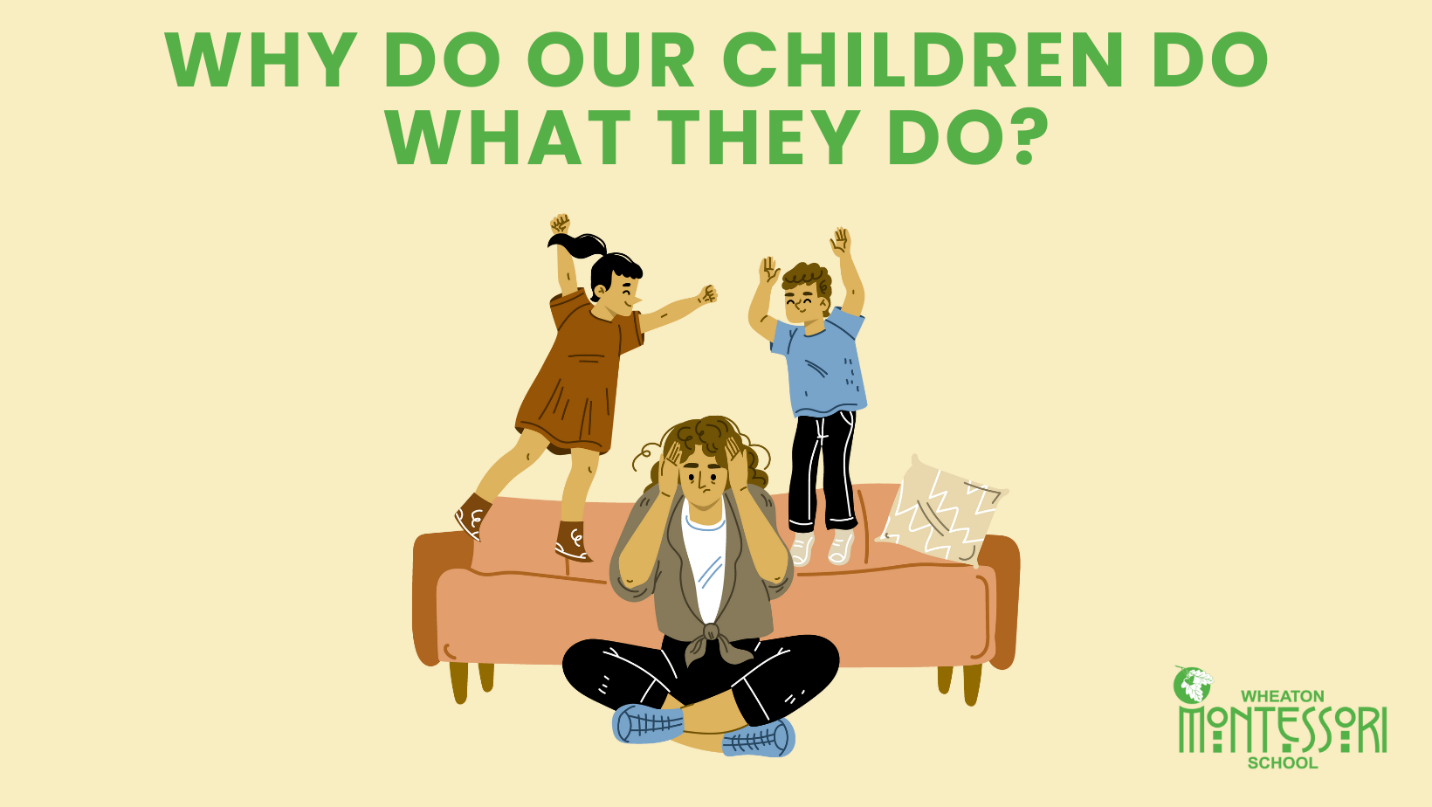
The scene may feel familiar, jumping on furniture or sitting down for a family dinner where our youngest starts tapping their spoon against a bowl, fascinated by the sound it makes. Our middle child begins asking a series of questions: “What does it mean to get an education? Why do people go to school? Why was Malala shot? Why are there wars?” Our oldest starts getting frustrated with the other two, wanting them to follow directions and have their dinner places in order.


In that chaotic moment before dinner, it’s easy for exasperation to take over. As adults, we might sometimes wonder what in the world propels our children. Really, what are they thinking when they try making holes by poking the table with a fork?


Innate Human Tendencies


We are born with innate human characteristics. We are hard-wired to explore, work, connect, and communicate. We crave order in our surroundings. We imagine possibilities. We create. We need to orient to what is around us, move our bodies, and wonder about the how and why. These human tendencies are unconscious, universal drives and they are at play our whole lives.


The newborn has familiar landmarks when hearing their mother’s heartbeat. When allowed to be on the floor, the infant rotates their body and moves in amazing ways. This drive to move propels babies into scooting, crawling, and eventually coming to that upright position that frees them to use their hands to explore the environment. 


We recognize these needs in our infants, yet that vital life force is powerful for older children, too. When our children are exploring the noise of the spoon against the bowl, they aren’t trying to aggravate us. They are just exploring cause and effect and delighting in the auditory result. When your teenager wants to stay in their bedrooms, they aren’t rejecting family, but fulfilling a desire for mental solitude.


Awareness of Internal Drives


Knowing that children are compelled by basic human tendencies, let’s explore these tendencies and help our children become their best selves. 


Your home and Wheaton Montessori School provide children with a sense of order. Knowing where one’s things go and how to help contribute to a task provides children with a sense of security and belonging. Just think about the feeling of uncertainty you can get when you visit someone’s home and don’t know whether to take off your shoes, where to hang your coat, or even how to be useful. By making sure our children feel welcome and purposeful and providing consistent routines, we help children develop an orientation to the world that they carry into all future settings.


You and your teachers prepare children for routines and offer accessible spaces that allow them to participate in the functioning of the day. They can help set the table, feed the cats, gather the laundry, prepare their lunches, and so much more. By participating in a meaningful way, they feel significant and ultimately more confident.


Our children’s constant questioning merely comes from a need for intellectual exploration. These big questions speak to their newfound mental ability to ponder expansive ideas about the world. As our children venture into new territory, either physically or intellectually, they benefit from opportunities to test their ideas and make connections to what they already know.


As social beings, we have to learn ways to collaborate effectively. The earliest humans had to cooperate to survive. An older child trying to force cooperation may just need some light support to find a way to communicate and connect with younger peers or siblings, rather than lapsing into exasperation. 


Supporting Development


Human tendencies are unconscious, universal drives that support our adaptation to our particular time and place. We are hard-wired to adapt to our environment! The human tendencies – to orient, explore, order, abstract, imagine, calculate, work, be exact, perfect oneself, and communicate and associate with others – help aid this adaptation. They provide the internal drive to become our best selves. 


Have you heard the phrase “Follow the child”? At Wheaton Montessori School, our classrooms and curriculum are designed with these human tendencies in mind, with particular attention to how these innate drives manifest themselves at different stages of development. Constructing curricula and classrooms around students' developmental needs and stages is exactly what Dr. Maria Montessori purposely designed and the benefits of these approaches supported. 


Thanks to our Montessori training and commitment, we recognize, honor, and support innate characteristics in children so we aren’t obstructing their important development. Our children reach amazing heights with Montessori support. Please contact us to observe classrooms or tour the campus.
Adolescent Seminar Observation Ms. Searcy’s Upper Elementary Classroom Observation Mrs. Fortun’s Lower Elementary Classroom Observation Mrs. Mayhugh’s Lower Elementary Classroom Observation Mrs. Berdick’s Primary Classroom Observation Ms. Carr’s Primary Classroom Observation Ms. Chiste’s Primary Classroom Observation Mrs. Rogers’s Primary Classroom Observation
Students in classroom with headline
By Kelly Jonelis, Adolescent Program Director and Math Teacher January 12, 2026
Where Learning Supports Who They Become Inspired by the Deep Dive on Psycho-Disciplines by David Kahn and Michael Waski In Wheaton Montessori School’s Adolescent Program, learning is more than content acquisition; it is a Psycho-discipline. A psycho-discipline is the connection of each discipline to the psychology of the developing human. When children and adolescents engage in subjects in a way that aligns with their psychology and developmental needs, the learning becomes internalized, and since discipline's root meaning is connected to “accepting with love”, they are supported to love learning. At Wheaton Montessori School, every subject your adolescent studies, from math, science, language, and literature to economics, morality, and culture, is intentionally crafted to support who they are becoming. We don’t teach disciplines simply to transmit facts. We use the subjects of humanities, math, social sciences, language, and sciences to strengthen your adolescent’s confidence, character, and capacity to participate meaningfully in society. This approach is deeply rooted in the Montessori work of David Kahn and Michael Waski, both pioneers of adolescent training programs and adolescent psyche work. They describe these subjects as psycho-disciplines. Psycho-discipline can be defined as the order necessary for self-construction. When children and adolescents engage with subjects in a way that aligns with their psychology and developmental needs, the learning becomes internalized. It becomes part of your children and adolescents. And when the curriculum is deeply connected and part of each individual, the result is self-construction that is whole, complete, interdisciplinary, and integrated. Wheaton Montessori School staff are trained to understand and respond to developmental needs and to aid your children and adolescents in loving to learn across the curriculum. We do this for adolescents by connecting the academic topics we cover to real-life applications that are meaningful and relatable for the student. Rather than teaching facts and skills in a silo “just in case” students may need them, we first present students with meaningful context and then move to presenting lessons that give them the tools they need to engage with that context, “just in time.” Psycho-disciplines: • Engage intellect and emotion • Build purpose through real work • Support the drive for belonging and contribution • Empower independent thought connected to others • Spark passion and identity formation Your adolescents learn to navigate complexity by applying their advanced knowledge to real needs. They learn academics best and enjoy them most when they use what they know to strengthen their community and improve the world. This applies whether they are solving problems that arise within their immediate environment or finding opportunities to serve the broader local community. At Wheaton Montessori School, 7 th -9 th graders engage in learning that is meaningful to them. They begin with recognizing authentic needs around them, extending the growing season in their gardens, keeping their chickens and bees healthy through the year, and then working to address those needs. When we provide the “big picture” first, students enter academic lessons with a clear understanding of why the content matters. Instead of teaching unit conversions or graphing equations in isolation and waiting for the question, “When am I ever going to use this?”, we begin with harvesting honey and ask, “What do we need to know to bottle and sell this honey? How do we determine the right price?” This is psycho-disciplines in action. Thermodynamics becomes relevant as students prepare their beehives for winter. Through this work, your adolescents also come to understand their value and place in the broader adult community, whether they are partnering with organizations such as People’s Resource Center or volunteering at Northern Illinois Food Bank. Learning through psycho-disciplines supports who adolescents are becoming and engages the work of the hand, head, and heart. Wheaton Montessori School adolescents don’t learn by memorizing facts, but by engaging and immersing themselves in meaningful work. This provides the means to learn lessons that speak to who the students are and to stick with them for a lifetime. Why Learning with Purpose Your adolescents are forming their adult identity right now. They are asking: How do I contribute? Where do I belong? Why does this matter? At Wheaton Montessori School, psycho-disciplines answer those questions through: • Meaningful collaboration • Real-world application • Guidance from experts and highly skilled mentors • Leadership and ownership • Choice and autonomy Instead of prioritizing the mere transmission of knowledge, we open the doors to further study and provide the order necessary for the formation of maturity and self-respect.
Children at tables, parents interacting, Montessori school setting. Title: Lighthouse Parenting.
By Christine McClelland and Rebecca Lingo January 5, 2026
Lighthouse Parenting helps children navigate life with guidance and freedom, building the skills and confidence to grow into resilient, independent individuals.